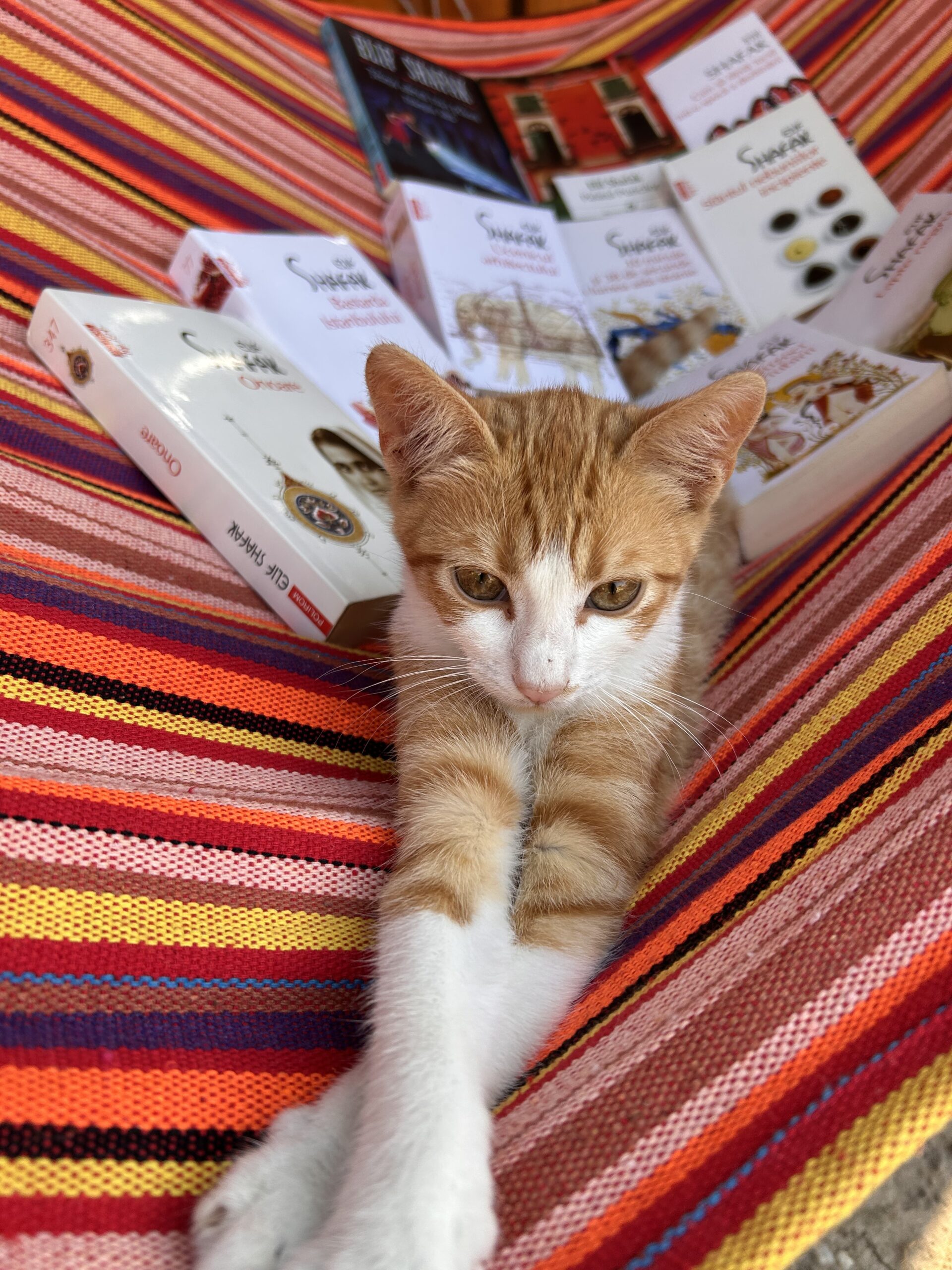
Choosing ten favorite authors is almost impossible. Our relationship with books changes and I am sure that if I searched deeper into my memories, thinking about the writers who influenced me at different moments of my life, this list might look completely different.
So this is not meant to be a definitive list. It is based mostly on my more recent reading and on who I am as a reader today, at 36 years old. These are the authors I currently feel most attached to, the ones whose stories have stayed with me after I closed their books, and whose names on a cover are often enough to make me curious about the book.
Maybe in ten years the list will change. I actually hope it will. Reading, like travelling, should keep changing us. But right now, these are the ten writers I would return to without hesitation.
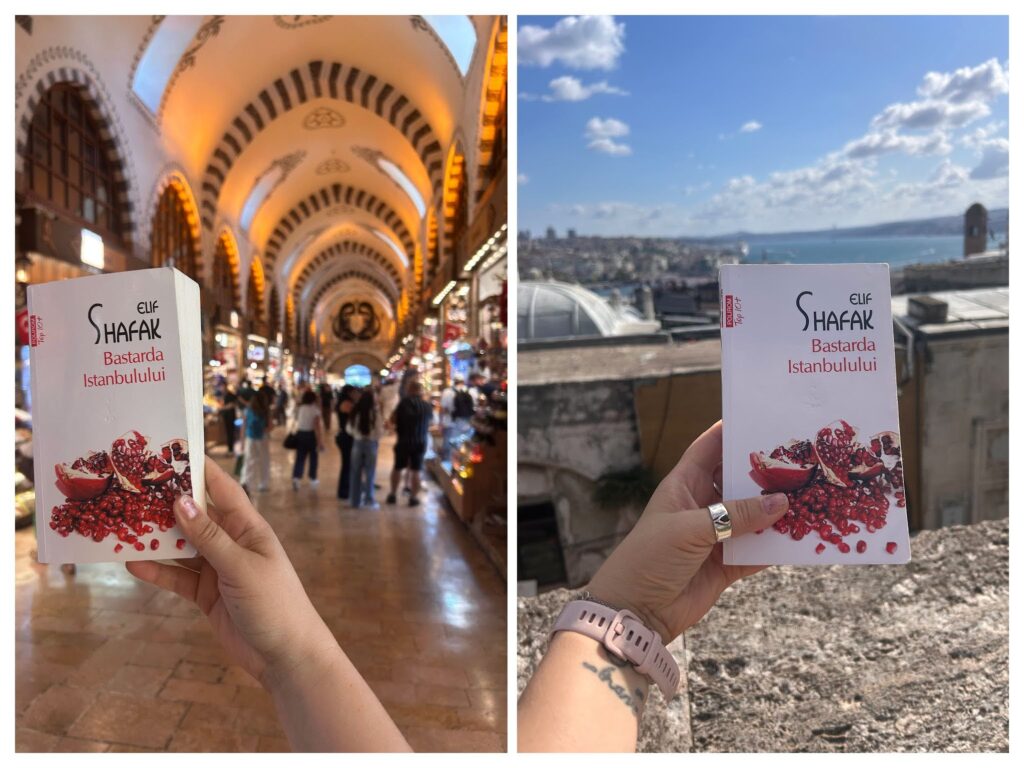
- Elif Shafak
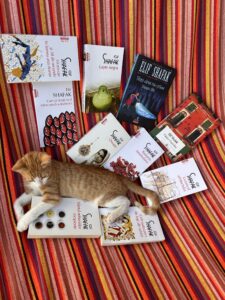
I discovered Elif Shafak through a recommendation, and once I found her voice, I simply couldn’t stop reading. I became fascinated by the depth of the relationships between her characters, by their contrasts and contradictions, and by the originality of the subjects she chooses to explore. Her constant blend of cultures, traditions and folklore with modern life and the freedom to choose one’s own path makes her not only an author I love reading, but also a person I could listen to endlessly.
If I had to describe what stays with me after reading Shafak, beyond her belief in the power of love and empathy, it would be the strength she gives to voices that literature has often left in the background. Her characters carry different cultures, identities, beliefs and wounds, and she allows them to exist with all their complexity. Again and again, she touches on ethnic conflicts and historical injustices, particularly those suffered by people whose stories were silenced or overlooked, while showing how collective trauma does not simply disappear with time. It travels through families, relationships and generations, quietly shaping the present.
This is what keeps bringing me back to her books: she reminds me that understanding another person’s story does not necessarily mean agreeing with it, but it can make the world a little less divided.
- Haruki Murakami

Haruki Murakami keeps me close in a completely different way. It is not necessarily his subjects that fascinate me. I am not particularly passionate about jazz, nor do I always feel connected to his characters. It is his style that gets under my skin, almost obsessively, and the strange universes he creates that keep pulling me back.
There is something addictive about his magical realism, his mysteries and the absurdity of situations that somehow feel perfectly natural while I am inside them. Yes, themes are often recycled from one novel to another, and yet I keep falling into the same trap. The moment the fog begins to descend over the narrative, I am caught. The less I understand what is happening, the more desperately I want to keep reading, convinced that somewhere ahead I will finally find the missing piece that makes everything clear.
But Murakami rarely gives me that satisfaction. His endings don’t really close the door. Instead, they leave me suspended somewhere between realities, still wondering what was real, what wasn’t, and whether that distinction ever mattered in the first place. Sometimes, that is exactly why I keep returning to him: every time I enter Murakami’s universe, I know I may never completely find my way out.
- Han Kang

Han Kang was a revelation to me. I think of her as a poet of pain, a writer capable of exploring the anatomy of suffering with an almost unsettling beauty. Her characters often seem to sink deeper and deeper into a swamp of despair as the story unfolds, and yet there is something in the way she writes about their pain that makes it impossible for me to look away.
It is not the suffering itself that draws me to her books, but the way she transforms it into something deeply human. Her writing makes me slow down, feel uncomfortable and, above all, empathize. I find myself not only connecting with her characters, but somehow with the sensitivity behind the person writing them. There is a quietness in her prose even when she writes about violence, trauma or unbearable loss. That could be what moves me most: Han Kang doesn’t simply describe pain, she gives it a voice, a shape and, sometimes, a strange kind of beauty.
- Narine Abgarian

Narine Abgarian is another poet of suffering for me, but one whose writing is filled with an extraordinary amount of tenderness and hope. She writes about the consequences of the conflict between Armenia and Azerbaijan not through politics or grand historical narratives, but through the lives of ordinary people who are forced to carry the weight of decisions made far away from them. Her prose can be incredibly gentle and yet deeply impactful, and I am grateful that voices like hers exist — voices that bring us closer to the human suffering hidden behind the war.
What touches me most is that suffering never completely defeats hope in her stories. Love survives in the smallest things: food shared with someone, a neighbour offering help, a familiar ritual, a moment of humour or simply the decision to continue living. Poverty, war and loss are always present, but so are affection, generosity and hope.
I also love the authenticity with which she brings Berd and its people to life. Through her writing, we enter small rural communities living close to the borders of conflict, where everyday traditions and simple lives stand in powerful contrast to the extraordinary sacrifices people are capable of making. Abgarian reminds me that even in places marked by war and loss, life continues in small gestures, and sometimes those small gestures are precisely what makes it worth living.
- Carlos Ruiz Zafón
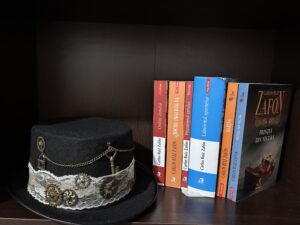
Carlos Ruiz Zafón won me over through his extraordinary ability to create mystery. I love the way he blends detective fiction with the Gothic and the fantastic, while weaving historical drama, family secrets and relationships across generations into stories that constantly make you feel there is another layer waiting to be uncovered.
But what fascinated me most was Barcelona. Zafón transformed the city into a character as alive as any of his protagonists. While reading him, I could imagine myself getting lost in its streets, feeling the fog settling over the city and seeing its old buildings become part of the mystery. His Barcelona feels dark, melancholic and seductive, a place where every street could hide another story.
Beyond this Gothic universe, what makes *The Cemetery of Forgotten Books* so special to me is Zafón’s fascination with books themselves. Books become almost living objects: they preserve memories, connect people across generations and sometimes seem to choose their readers rather than the other way around. At the centre of the entire series lies something I find irresistible, the idea of creation itself and the strange power stories have to survive their creators. Few writers have made me want to physically enter a fictional world as much as Zafón.
6. Guzel Yakhina
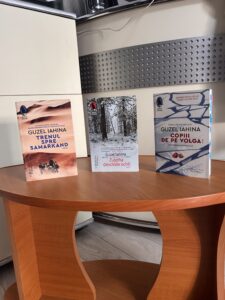
Guzel Yakhina is, for me, a writer of survivors. She writes about some of the darkest chapters of Soviet history and about the devastating consequences they had on ordinary people, including ethnic minorities whose stories can so easily disappear behind the larger historical narrative.
Her novels are filled with displacement, hunger, fear, death and helplessness, and yet I never feel that she allows darkness to completely take over. Somewhere in every story there seems to be a horizon of salvation, a small light flickering at the end of the tunnel, sometimes barely visible, but still there. Even when survival seems almost impossible, her characters continue to search for something to hold on to.
Despite the historical period she chooses to explore and the weight of the subjects she carries, Yakhina brings something surprisingly fresh to Russian literature. Her novels have the scale and intensity I associate with the great Russian storytelling tradition, but her voice feels contemporary, vivid and deeply human.
7. Isabel Allende
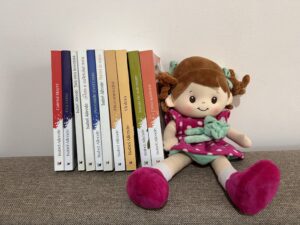
Isabel Allende represents another side of magical realism for me, but what draws me most to her writing is the extraordinary strength she gives to female destinies. There is something almost precise, even methodical, about the way she constructs her stories. When I look at her work as a whole, I can almost see the mechanism behind it: characters rise and fall, love and lose, leave and return, while history keeps moving around them.
Whether she takes me to Chile or to the American West, I know I am going to follow characters across years, sometimes generations, watching them being shaped by political upheaval, migration, family secrets, love and loss. Her women, in particular, rarely remain the people they were at the beginning. They are forced to adapt, rebuild themselves and continue, even after experiences that could easily have broken them. Magical elements may float through her stories, but underneath them I always find something very real, an extraordinary capacity to survive and keep moving forward.
- Kate Morton

Kate Morton appeals to the part of me that loves both history and mystery. Her novels feel like puzzles built from memories, old houses, family secrets and stories buried for decades, waiting for someone in the present to uncover them.
What I enjoy most is the way she moves between different timelines, slowly revealing how the past continues to shape the present. There is almost always a house, a garden, a forgotten letter or an old photograph that holds more than it seems, and I love following those small clues until the different pieces of the story finally come together.
Morton plays with something I have always found fascinating: the idea that places preserve traces of the people who lived there and that behind an apparently ordinary family story there may be an entire hidden world.
Her books are the literary equivalent of opening an old box in an attic and finding a photograph of people you don’t recognise. You immediately want to know who they were, what happened to them and why their story was forgotten. And I will always be curious enough to keep reading until I find out.
- Fredrik Backman
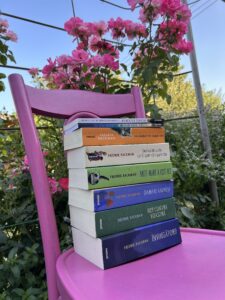
Fredrik Backman’s writing can seem deceptively simple at first, almost as if his stories could belong to children’s literature. And then, somewhere along the way, you realize how much pain his characters are actually carrying.
This contrast is what keeps me close to him. Behind the humor, the warmth and the ordinary lives are people dealing with grief, loneliness, failure, fear and deeply rooted trauma. Backman has an extraordinary ability to create imperfect and sometimes difficult characters, then slowly reveal the wounds behind the way they behave.
But what touches me most is the way healing happens in his books. His characters rarely save themselves entirely on their own. They heal through other people, through friendship, kindness, unexpected relationships and, above all, through community. His stories remind me that sometimes belonging somewhere, and having someone willing to see beyond your wounds, can be the beginning of finding your way back to yourself.
- Fiona Valpy
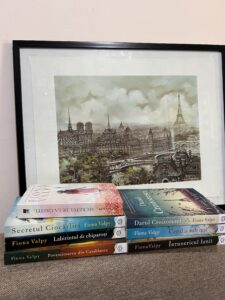
Fiona Valpy is probably the best example on this list of an author I return to not necessarily for the complexity of her writing or her characters, which can sometimes feel rather simply constructed, but for the places she creates around them. Her greatest strength, for me, is atmosphere. Through the small details she chooses, I don’t simply imagine the setting, I feel as if I am travelling through it. From Scotland to Paris, Florence or Casablanca, her books give me that wonderful sensation of being transported somewhere else, which is one of the things I value most in fiction.
I also admire the way she repeatedly returns to the Second World War, exploring how the same historical tragedy affected ordinary people in completely different corners of the world. The war becomes a thread connecting places, generations and personal dramas, while each location gives the story its own identity.
Some authors make me fall in love with their characters, Fiona Valpy makes me want to pack my bag and discover the places where their stories unfold. And for someone who has always travelled through books before travelling through the world, that is more than enough reason to keep coming back.