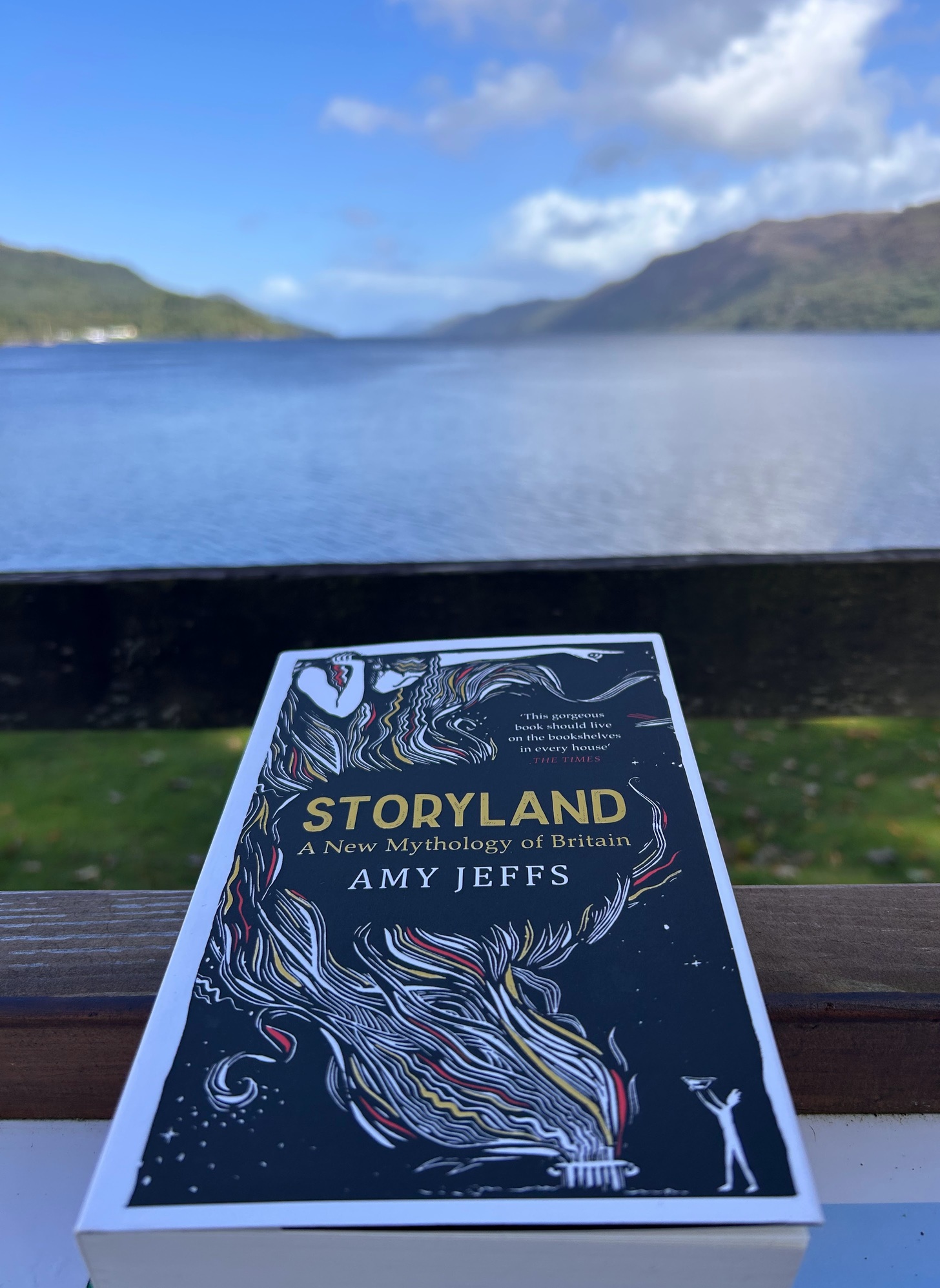
Some places are famous long before we reach them, we recognise their symbols, as if they already belonged to our memories. Loch Ness is one of those places with its dark waters and the mysterious creature believed to live beneath their surface. Yet behind the familiar image of Nessie lies a much older story one that Amy Jeffs brings back to life in Storyland: A New Mythology of Britain.
I chose to read Storyland during travelling through Scotland because I wanted to understand the country beyond its castles, dramatic landscapes and famous historical figures. As an art historian and printmaker, Amy Jeffs returns to medieval manuscripts to retell the myths that shaped Britain. Her stories lead readers across a landscape inhabited by saints, giants, warriors and supernatural beings. Accompanied by her own illustrations, they feel ancient and contemporary at the same time.
The book transforms geography into something more than a collection of physical places, mountains, rivers, islands and ruins become witnesses to stories passed down for centuries. Loch Ness belongs perfectly within this world, where history, faith and imagination constantly overlap.
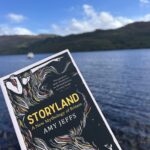

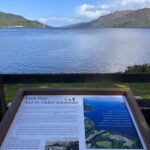



Before Nessie: Saint Columba and the Water Beast
The earliest written story associated with the Loch Ness Monster is not a modern account of an unexplained shape photographed on the lake. It appears in The Life of Saint Columba, written by Adomnán of Iona in the late seventh century, around a century after the event it describes.
According to the story, the Irish missionary Columba was travelling through the land of the Picts in approximately AD 565 when he encountered a group of people burying a man beside the River Ness. They explained that the man had been attacked and killed by a water beast while swimming.
Columba then instructed one of his companions to swim across the river. When the creature emerged and moved towards the swimmer, the saint raised his hand, made the sign of the cross and ordered it to go no farther. The beast immediately retreated, and those who witnessed the event regarded the rescue as a miracle.
An intriguing detail is often lost in modern versions of the legend: the medieval account places the encounter in the River Ness, which flows from the loch, rather than in Loch Ness itself. It was also written as a story demonstrating Saint Columba’s divine authority, not as an attempt to document or identify an unknown animal. Nevertheless, it later became connected to the mythology surrounding Nessie and is frequently described as the earliest written reference to a mysterious creature in the area.
Amy Jeffs does not treat legends as simple historical evidence or ask whether every event happened exactly as described. Instead, she explores what these stories reveal about the people who preserved them and the landscapes to which they became attached.
From a Medieval Beast to a Modern Monster
The creature confronted by Saint Columba was not yet the friendly, long-necked Nessie found today on signs, souvenirs and children’s toys. Medieval water beasts often represented danger, chaos and the unknown. In the story, the creature’s purpose is to create the conditions for a miracle: nature becomes threatening, and the saint restores order through faith.


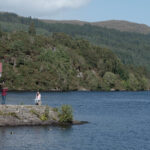
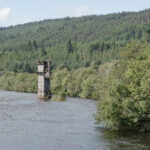
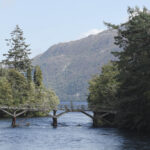
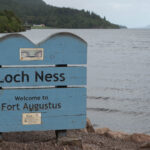
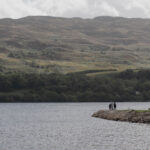
Over the centuries, however, the meaning of the creature changed. The frightening beast of the River Ness gradually became the elusive inhabitant of Loch Ness. During the twentieth century, reported sightings and widely circulated photographs turned Nessie into an international phenomenon.
The monster moved from medieval hagiography into newspapers, documentaries and popular culture. Yet the heart of the legend remained the same: something may be hiding beneath water that human eyes cannot penetrate.
Perhaps this is why the mystery survives despite the lack of conclusive evidence. Nessie belongs to the space between knowledge and imagination. Proving or disproving the creature may be less important than the possibility of its existence.
Visiting Loch Ness with Storyland in Mind
Travelling to Loch Ness after discovering Amy Jeffs’s work made me see the landscape differently. I was not simply visiting the home of Scotland’s most famous monster. I was entering a place where a medieval saint’s legend, the history of the Picts and modern popular culture have become intertwined.
It reminded me why I enjoy reading local literature before travelling. Books reveal layers of a destination that cannot always be seen in its monuments. Without the story of Saint Columba, the River Ness might appear to be only a river. Through the medieval account, it becomes the setting of an encounter preserved for more than thirteen centuries.
Storyland also reminded me that legends are not fixed, they travel across time, changing as each generation retells them. A dangerous medieval water beast becomes the Loch Ness Monster; the monster becomes Nessie; and Nessie becomes an enduring symbol of Scotland.
Amy Jeffs’s Storyland encourages us to approach places with curiosity and to listen for the older stories beneath their modern identities. Storyland: A New Mythology of Britain is an illustrated retelling of Britain’s medieval myths and legends by historian and printmaker Amy Jeffs. The account associated with the Loch Ness legend originates in Book II, Chapter 28 of Adomnán’s Life of Saint Columba. Read more about Amy Jeffs and Storyland.