Written during and after my journey through India in 2019–2020, these journal pages bring together moments of volunteering, discovery and human connection. From schools and community projects to sacred cities and unexpected meetings, they reflect on the experiences that shaped my travels and stayed with me long after I returned home.
Ready for volunteering in India
Published by Ramona Diac on November 29, 2019
Choosing the volunteering path is one of the best decisions I’ve ever made in my life because it makes me happy, thankful and grateful for each moment and person in my life. I don’t know if it exists a recipe to get ready for volunteering but I do know that in order to have a meaningful contribution, it’s useful to prepare yourself for this experience. I am going to volunteer for six months in India after three months of traveling in South-East Asia and I had to plan everything before, that’s why I would like to share some tips with you if you’ll ever decide to take this path in life.
Why I chose India? I have to recognize that I was inspired by stories and insights of other volunteers that were in India and came back totally transformed. I had the opportunity to learn more about the projects there and I became slowly fascinated by the idea of stepping inside the Indian civilization. The last reason is connected with the historical roots of Roma communities, I was a teacher in Romania and I had the chance to work with gypsy communities too. I think my experience in India could help me to understand more about these communities and in the future to be more prepared for working with them.
In order to volunteer in India for a longer period, you need to take care of the practicalities too like getting the visa, taking vaccinations and researching more about their customs and their society. The visa process was the most stressful from all these because it wasn’t the option to apply for a volunteering visa or another kind of visa than the working one so it wasn’t so easy to obtain it. Because this process is different from country to country, I will write another article specially for this to present how Roumanians could get a working visa for India. Concerning the vaccinations, you are not forced to take any but it’s better for your health to prevent getting sick so I would advise you to do some personal research and do what you consider that you need. You could find more information on this site https://wwwnc.cdc.gov/travel/destinations/traveler/none/india. In my case, I took Hepatitis A, Typhoid, Cholera and the shot for Diphtheria, Tetanus, and Polio (also known as DTaP). My teammates took also Rabies but I prefer to avoid the animals as much as possible, anyway it’s good to have it too.
I received the advice to be ready for the cultural shock in Indian society. It’s hard to imagine how I would feel there but I’m preparing myself to enter a different world where traditions are religion are very important for the people and to set my mindset for being a guest and not an intruder in their system of values. As a woman traveler, it’s better to avoid unnecessary attention, by wearing clothes that cover your legs and your shoulders and by avoiding traveling alone by night. In some cases, maybe I will feel outraged as a foreigner woman in India, but I hope to have the right attitude to overcome each challenge that I will meet there. I don’t know what to expect from this beautiful and mysterious India but I will let myself free to explore and enjoy each step on the way.
Free School Under the Bridge
Published by Ramona Diac on December 7, 2019
The second day in India…still confused after getting in this different universe but curious to discover its mysteries. I started the day with an Indian breakfast on the street, I got in love with paneer paratha and with the craziness from Delhi’s streets. India has its own charm in a way that either you become irremediable in love or you start to hate it and wish to leave it as soon as possible. Maybe it’s too soon to say it… but I like more and more the ways in which India is challenging me and offering me answers without asking a question.



In this way, I found the Free School Under the Bridge, a wonderful experience to have especially when you don’t expect it. I’m sure the roads in India could drive you to places that you’ll never expect but arriving under that bridge was a lesson of perseverance and determination in the face of poverty. Rajesh Kumar Sharma, the founder of this school came with this idea in 2006, being motivated to provide access to education to children from the slums. I was walking in the middle of nowhere when suddenly I became a witness to another type of school. I was thinking that is a random playground at the beginning until I saw the students and the supervisors there. Not knowing what is this place, I stepped into their school without being invited and I was more than welcomed.
The first thing that I noticed was the joy on the kid’s faces coming to this school, a group of girls were arriving at that moment running to have their place under the bridge. Without a teacher to invite them to study, they were starting to play some board games together. I didn’t want to invade their space but when they noticed that I’m watching them, they came to me and presented themselves. I’ve tried hard to pronounce correctly their names and the girls were really happy to teach me. When I couldn’t pronounce one name for the third try, one of them kindly told me: “it’s ok, I know it’s hard”.
The school is run in two shifts, in the morning for boys and in the afternoon for girls, students aged between four and 14 years, enrolled in the governmental school nearby. Seven teachers are volunteering to teach these children in their free time, a proof of generosity and willingness to overcome the challenges of poverty. Free school under the bridge doesn’t have a permanent building, the bridge next to Yamuna Metro station provides its shelter and the wall next to it is used as a blackboard.
When I asked how we could help this initiative, the founder told me firmly that there is no money involved. For my second visit, I plan to bring some teaching materials and games for the children because some of them are most of the days there and they love to play by themselves. After this random visit, I know that the children will be happy to meet new people and for the next time I want to do something more meaningful. The free school under the bridge is a place where children are feeling safe in the same environment that gives them challenges.
The power of people in Panipat
Published by Ramona Diac on December 8, 2019
I had the chance to arrive in Panipat to work for one month in a project of Humana People to People India, called Action against Child Labour. Child Labour represents one of the biggest challenges in India, where is the highest number of children “economically active” in the world, more than 31 million (2017). Panipat is a centre of the textile industry in India and Humana People to People India (HPPI), since 2015, has worked to get children out of the factories and enrolled back into schools.
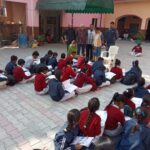

This initiative is involving all the community from Panipat because on one hand, they have mobilizers that are trying to engage the factories owners in refusing to hire children and in becoming partners in this action. The project is focusing also on the power of women groups in each district that are identifying kids working in these factories. On the other hand, this project is proposing alternative ways of education for the children that were involved in child labour in order to be enrolled in governmental schools. The children that worked in factories are firstly trained in HPPI’s Kadam Centres (6 to 11 years old) or in the newly established Bridges Schools, designed to accommodate adolescents between 11 to 18 years old. In this way, the network of this project is gathering together the entrepreneurs from the region, the groups of women, the teachers and the public institutions.
One important aspect of this initiative is tracking the children’s progress during the alternatives schools and when they reach the level of education according to their age, monitoring their evolution in governmental schools. This is a strong team working between the teachers from Humana’s educational programmes and the public schools. I was totally impressed by the power of community and the openness of people working together. This is a huge step forward but the challenges are still here, the poverty and the lack of education are the principal causes of child labour and they are hard to overcome.
What are we supposed to do in this programme? Firstly, we visited the community and tried to understand how the project is working, that’s why we saw some factories that became partners in this action and we assisted at some group women’s meetings and visited the Khadan centres, Bridges Schools and Public Schools from the community. The main part of our contribution will consist of working with the Bridges School by implementing STEM projects for the students there. This interactive way of teaching has the goal of raising the student’s curiosity and autonomy in learning.
After visiting the community, I felt a small piece in a chain of connections between people. India has its unique way of making you feel welcomed and part of the community. But from all the experiences I was impressed the most by the joy of women group inviting us to assist at their meeting. All I could have felt was the power of people together facing the same challenges and I hope I can be part of their togetherness.
Our first class of astronauts
Published by Ramona Diac on December 10, 2019
Today was our first day working in a school in India and I loved it! For the next weeks, we will implement some STEM Module in the Bridge Schools in which children involved in Child Labour, are studying before being ready to go to the governmental schools. STEM is a project-based curriculum, educating students in four subjects: science, technology, engineering, and mathematics, in an interdisciplinary and practical approach. I am passionate about the universe and I proposed to implement a Solar System STEM Module.
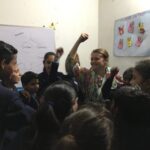
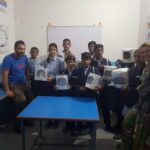
The first step in our journey was to create the story around the projects that we will put into practice. So, on our first day, we created a class of astronauts by confectioning an astronaut kit for each student from the class. After having this astronaut costume, we will explore the space and we will have different missions to accomplish. Our idea was to use things that we could reuse by demonstrating that garbidge could become bring some fun in the class.
I didn’t expect anything from today’s activity, I just wanted to start working with the kids but they were amazing smart, curious and open to trying something new. They got involved in the process by bringing cartoons and recycling plastic bottles. It’s beautiful chaos in their joy and way to deal with learning because they are very active and willing to use their hands. I was impressed by their dynamism and happy until the bottom of my heart because they were implicated in our story.
We want to develop this STEM Module for boys and girls in the same class and I was curious about the relation between them in the same activity. Even if there were some tensions regarding sharing the resources that we used, in the end, they were helping each other to finish at the same time. This part was a lesson of avoiding judgment for me because I was afraid that they can not work too well together. The reality is that children are the same everywhere, they love to play together and they help each other in their playing time.
I and my colleague Ivo heard for three hours Madame and Sir from the students that were incredibly happy to show their progress of the task. It was a day about working and having fun together by creating an astronaut kit that we’ll help us to explore the universe…
Varanasi a mystical place in India
Published by Ramona Diac on December 24, 2019
If I could have taken pictures with the smell inside them, the photos of Varanasi will become one of the most special memories of my traveling period. I came to visit Varanasi knowing that is one of the most sacred places for Hinduism, being considered as the spiritual capital of India. What I didn’t know before was that this place will give my first cultural shock in India.
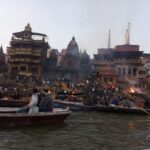


Varanasi is situated on Gange River, in the northern Indian state of Uttar Pradesh. It’s a city with a long history, being dated since 11 century B.C. According to Hindu mythology, Varanasi was founded by Shiva one of three principal deities along with Brahma and Vishnu. The spiritual importance is given too by the location of 2,000 temples in Varanasi, including Kashi Vishwanath, the “Golden Temple,” dedicated to the god Shiva.
Two natural elements are associated with Varanasi: the Gange River and the magic fire, life, and death. Hindus believe that dying here and getting cremated along the “holy” Ganges river allows one to break the cycle of rebirth and attain salvation. It sounds pretty mystical when you read about it but being here and seeing so many corpses lying on the steps of Manikarnika Ghat waiting to be cremated, made my knees feel weak. But the smell of corpses burning is a though experience that will stay with me for a while.
Somehow we have a gift for choosing good places to sleep but well hidden and hard to reach even with a map. In Varanasi we did the same, we found a Guest House somewhere behind the Manikarnika Ghat…I still hear the people chanting carrying the bodies to the river. I still sense the heat of the big flames of magic fire. I still feel a contrast of emotions surrounded by these different people between sadness, grief, and a sort of peace. And finally, I still smell the dead bodies burning…Probably after I will understand more about the Hindu religion, I will be a witness to their funeral rituals but now I’m just a lost tourist in a twisted story.
Beautiful India has so many mysteries, it’s full of mysticism, hard for us to understand, that’s why I’m thinking if we, Europeans, are really so highly developed as we think. Maybe they know more about life and death…I will leave Varanasi intrigued to discover more about India.
The journey of a silkworm
Published by Ramona Diac on December 26, 2019
I’ve always considered traveling a learning process but it became a miracle when I was witnessing the journey of a silkworm. We are using so many times metaphors about the metamorphosis of a butterfly because it’s so inspirational for us, people, but do we really understand this process? I was lucky to visit an organic silk farm in Jamshedpur and understand a little bit more about this beautiful creature. This visit was possible because of my colleague, Karen Camilleri, who studied fashion design and became an activist for sustainable fashion.


Basically, the cycle of a silkworm’s life has these stages: eggs – caterpillar – cocoon – moth – eggs. In the process of making the silk, the heat kills the silkworms and the water makes the cocoons easier to unravel. Silkworms are boiled alive to obtain silk fiber to unravel the silk from the cocoon. The process of silk production is known as sericulture and it’s highly criticized by animal welfare because the moth is rarely leaving the cocoon alive.
In Jamshedpur, we visited COCCCON Natural avant-garde Textile, a revolutionary alternative of producing silk organically and respecting non-violence. What is the main difference? In this case, cocoons are pierced and trimmed so that the butterfly can fly away and not be scalded in boiling water. The broken silk filaments are hand twisted and traditionally weaved, which gives it its distinctive character. The organic silk is made by disadvantaged people from the rural poor in Jharkhand, eastern India. I had the chance to see all the stages of a silkworm in their farm and I honestly was amazed about the beauty of the cycle of life. I saw the caterpillars eating leaves and some of them starting the process of building the cocoon. I saw the cocoons room and some beautiful butterflies next to their cocoons even if it’s not their season. I saw the tree farm for the butterflies offering them an environment to live.
I feel grateful to see one of the most beautiful miracles of life and to understand that things can be done right if we care enough. I will always remember the journey of a silkworm when I will be down, without motivation because this is one of the most wonderful examples of how beautiful life is.
Taj Mahal: Love beyond death
Published by Ramona Diac on January 6, 2020
It is known about the Taj Mahal that is an architecturally perfect building, being one of the seven modern wonders of the world, but do we really know what is the reason for building this majestic monument?



The story says that Taj Mahal is actually a proof of devotion and love beyond limits from Shah Jahan to his wife Mumtaz. Born in 1592, Prince Khurram became Shah Jahan, the fourth Mughal Emperor of India. While strolling in Meena Bazaar in 1607, Khurram was mesmerized by a beautiful Persian noble girl, Arjumand Banu. He was 14 and she was 13 years old. They got married in 1612 and later, in 1628, when Shah Jahan became Emperor, he gave her the royal seal and the title of “Mumtaz Mahal”.
Shah Jahan and Mumtaz were devoted to each other, he loved her very much even though she was his fourth wife. Foreseeing his distress on her death, Mumtaz took a promise from him to channelize his love into building a magnificent monument. On her death in 1631, Shah Jahan vowed to build “Taj Mahal: Crown of Palaces” in her memory with a wish to be united with her in “Jannat”.
Shah Jahan wanted to build a second mausoleum across the Yamuna River where his own remains would be buried planning the buildings to be united by a bridge.
According to the Islam laws, his plans were criticized because he was spending too much money on these luxurious monuments and not with the purpose to eradicate poverty. So his son, Aurangzeb, his third son with Mumtaz, decided to send him in prison and took his power.
Shah Jahan spent his last years imprisoned in a tower of the Red Fort at Agra, having a view to the perfect place that he built for his wife. After his death in 1666, he was buried next to his beloved Mumtaz.
5 Things to do in Agra
Published by Ramona Diac on January 8, 2020
If you reach India, you should definitely visit Agra because it’s a place full of history and iconic historical buildings. It’s a tourist destination that I didn’t plan to visit now but some circumstances brought me here sooner so I decided to enjoy as much as possible my visit.
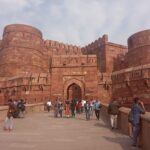
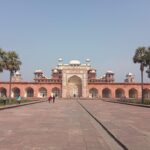
- Couchsurfing. In order to have a better traveling experience, I decided to do Couchsurfing, I love this way to travel and I recommend it for Agra too. It’s not only about cheap traveling but staying with locals is a big opportunity to understand more some behaviors and to know what you should do or shouldn’t do in different contexts. My host was an example of kindness with a lot of knowledge about India and a very good English. I received a lot of recommendations about what I shouldn’t miss exploring from India and a lot of stories of wonderful people that are doing good things in rural communities. It’s my second time doing Couchsurfing alone in India and I had great experiences both times.
- Have a morning walk in Sikandra and visit the Tomb of Akbar. I went there advised by my host because it will be interesting to notice how much this building influenced the construction of the Taj Mahal. It is an important architectural masterpiece of the Mughal era, located in Sikandra, a suburb of Agra. Although the tomb is the place where one of the greatest emperors of India is buried, the Mughal gardens around it present a beautiful and cheerful facade. In the morning, you can see their lots of dears, birds, and monkeys. It’s very peaceful and not so crowded, you could enjoy nature too. The ticket’s price is 310 rupees for foreigners and for locals it’s free in the morning in order to encourage people to walk.
- Visit a Sikh Temple. I got curious to visit a Sikh Temple before coming to Agra but I took the chance to do it here. From outside the temple is like a palace but going inside everything is simple, in order and very peaceful. What is good to know if you want the experience or if you don’t have any other options, these Gurudwara or Sikh Temples are offering accommodation and food in need. You could volunteer in the kitchen to help but they offer this help to everybody. I felt in peace there and I would want to experience staying a few days in a temple-like this in the future.
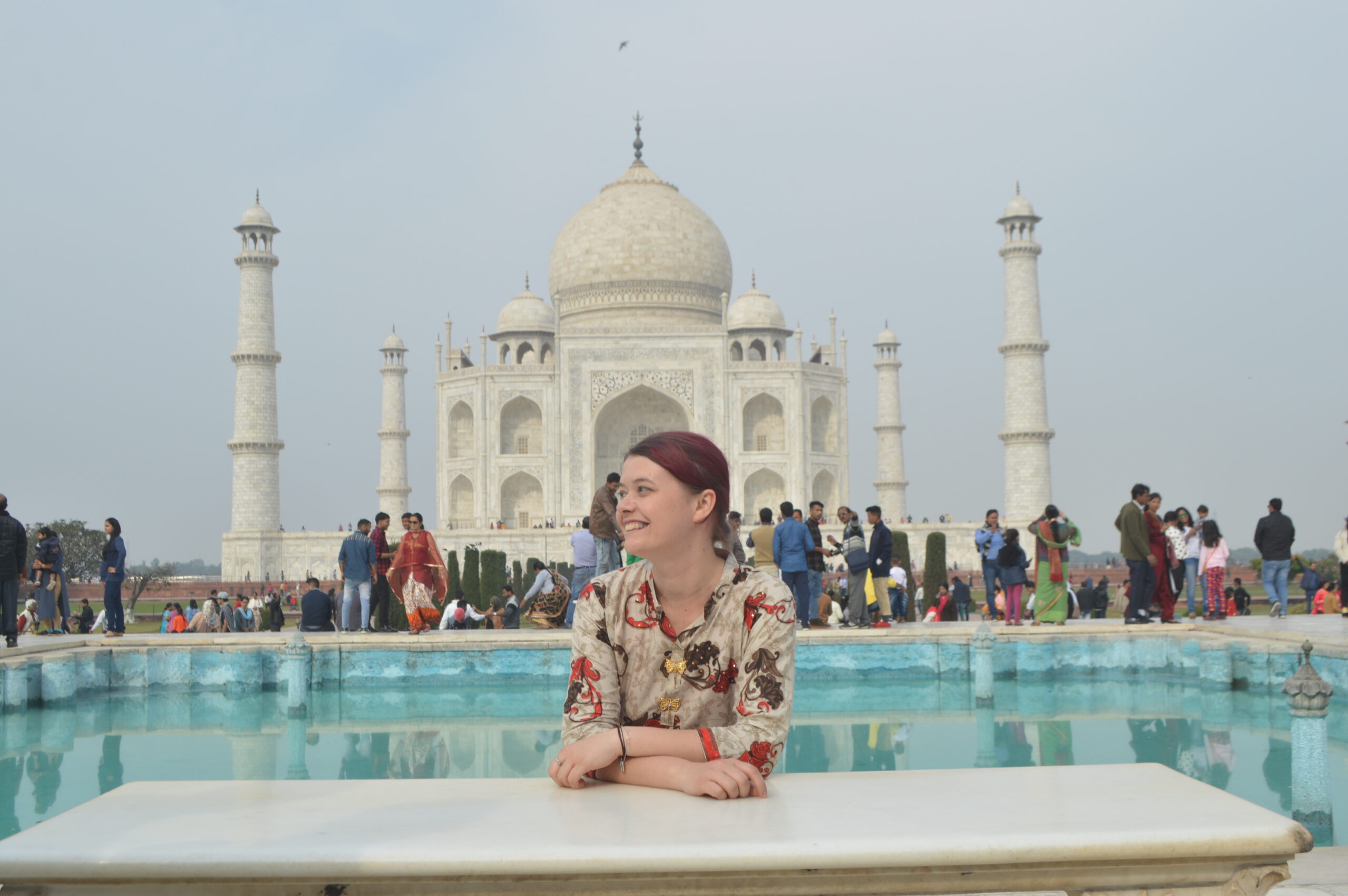
- Have a photoshoot at Taj Mahal. Taj Mahal is the most visited place in India, almost 7 mil tourists visited last year. I was thinking that I won’t be so impressed after seeing so many photos with people going there but…I was mesmerized by its beauty. So I took as many photos as I could and I enjoyed the walk in the beautiful garden even if it was quite crowded. I’ve read more about the story behind building this majestic monument and I was fascinated by the love of Shah Jahan to his wife. It was a beautiful afternoon full of smiles.
- Have a tour of Agra Fort. Agra Fort was the main residence of the emperors of the Mughal Dynasty until 1638 when the capital was shifted from Agra to Delhi. The fort is a UNESCO World Heritage site being built on an area of 380000 square meters. Agra Fort’s structure is formed by bricks and red sandstone was brought all the way from Rajasthan and that was laid on the external surfaces. This appearance of the fort underwent a major change during the reign of Shah Jahan, who was smitten by the beauty of white marble. He destroyed many structures within the fort, only to rebuild them using white marble. It is said that Shah Jahan used to view the Taj Mahal from a tower of Agra Fort built by himself after he was imprisoned by his son.
5 Things to do in Visakhapatnam
Published by Ramona Diac on January 24, 2020
Visakhapatnam or Vizag, shorter version, is one of the cleanest and relaxed cities from India. I came here at the recommendation of my host in Agra looking for a place to relax and enjoy the good weather. As a solo female traveler, I would say that it is pretty safe and easy to explore. Actually, another reason to come here was the curiosity of how they treat the women in the south part of India.
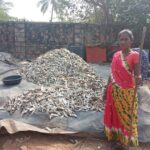


- Visakhapatnam Port is one of the 13 Major Ports In India and the only one of Andhra Pradesh. It is India’s second-largest port by volume of cargo handled. That’s why you should pay a visit to the fishermen harbor.
Fishing is one of the main occupations in Visakhapatnam. A lot of people are dependent on the sea and the harbor for their living. If fishing is a men’s job, drying the fish is done by women just outside the harbor.
I tried to speak with some women about their job, I didn’t succeed so well. The official language here is Telugu and English is not so common. Charvi and Dhitya are working in the sun all day, it takes three to four days for the wet fish to dry after applying salt on them. They were surprised to see me there but happy to show me what are they doing even if we didn’t understand each other. - Being a city on the sea, Vizag is known for its beautiful beaches. One of the most famous is the Rama Krishna Beach. It is a spectacular long beach on Bay of Bengal and gets its name from the Ramakrishna Mission ashrama across the Beach Road from the park. 16 kilometers outside the city is located Rishikonda Beach, one of the most beautiful, cleanest and popular beaches in Vizag. Here you have different options of practicing sports water because the waves are pretty high.
- I invite you to enjoy the city panorama from Kailasagiri, hilltop park. It’s a wonderful place where you could relax and take beautiful photos of the city and the sea. I went there by cable car and the ticket was 100 rupees.
- Visit the first Submarine Museum from South Asia. It’s about INS Kursura (S20) which was a diesel-electric submarine of the Indian Navy. Kursura was commissioned on 18 December 1969 and was decommissioned on 27 February 2001 after 31 years of service. She participated in the Indo-Pakistani War of 1971. Since 2002 it became a Museum ship and if you didn’t have the chance to see the inside of a submarine, you should definitely visit it. The ticket is only 40 rupees and if you want to take pictures, you could pay an extra 50 rupees.
- Have a moment of silence enjoying the panorama from Ross Hill Church. It’s a very beautiful place where you could see a perfect sunset. It’s close to the harbor and you could easily reach the sea from there.
The best time to visit Vizag is between October to March because the temperatures could go very high during summer. The food is amazing and the fruits the same, you should definitely try Biriyani with chicken. The people are welcoming you and you don’t feel them staring at you. I felt safe walking by myself. All in all, Vizag is a destination that you shouldn’t miss from India.
Traveling alone in India
Published by Ramona Diac on June 18, 2020
One of the most frequently asked questions after my trip to Asia was whether it is safe to travel to India alone as a woman. I tried to understand why I have received so often this question from women that they may be afraid of all the cultural differences between western and Indian civilization. However, I believe that my safe travel in India was due to the fact that I didn’t focus too much on the cultural differences but on the curiosity to discover a new world and to accept it as it is. Generally, I felt safe in India and I enjoyed all its beautiful chaos and unpredictability but mostly because it suited me. I love the rush, the energy, and the spirituality of mother India. I couldn’t assure all the women that will have my experience in India, however, I could give you some advice for having a better journey.



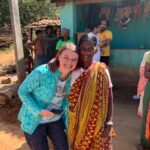


Start by doing a little bit of research before the trip. I’m not saying to learn all the history, the myths, and religion of India, even though it will help you a lot, but you should read at least the news, other travelers’ stories, and some information about their traditions and customs. The news – because your traveling plan could be affected by the political and social situation in the country at the moment. In my case, due to some manifestations in Delhi, many trains were delayed or canceled and some places were closed. On the same topic, be aware that India it’s a huge federal state so it’s possible to appear some political tensions between different states and the government. Usually, the touristic attractions are not affected by these situations, but if you plan to move a lot around India, you should be updated.
If you are inspired by other people’s stories, you should talk with people that already visited India before doing your traveling plan. It’s possible to hear about unknown places to visit and unconventional ways to travel. I loved to travel by train, which isn’t the most comfortable way to travel but it was the best way to feel India’s pulse. It’s also inspiring to read about spiritual experiences in India or about Indian hospitality so I encourage you to search as many stories as you can.
Concerning their customs, I advise you to cover yourself, woman or man both you’ll attract unwanted attention. You’ll find there a lot of Indian clothes very suitable for traveling and for the weather that will allow you to „fit in”. You can avoid uncomfortable situations if you cover yourself but you won’t avoid their starring. They will try to take pictures with you, you can always refuse if it’s too much for you, don’t try to be too polite, think all the time at what it’s truly ok for you. I was politely refusing all the men asking for photos saying that I prefer to take pictures only with women and kids and they were ok with it. However, at some point the crowd and the starring became hard to support so when my energy was low, I tried to avoid walking on the street alone or to go to crowded places.
If you move around through India, you’ll notice that the status of the woman in society is different between several parts of India. In the north is mostly patriarchy but going to south or south-east, you can observe that the women are more respected. I was hosted in a Bengali family in Kolkatta and I felt that the core of the family was the mother. I also noticed that they offer higher attention to women’s education. In Visakhapatnam, I’ve visited a school called „Mother – The first and best Teacher”. When I asked the principal about the school’s name, he told me: „In our country, we praise women as goddesses, they are very important in our religion. We celebrate them as being a source of energy and education. It’s natural to perceive mothers as the first and the best educators.” I’ve also heard that in the state of Meghalaya in far east India, women have a more important role because they have a matrilinear system for passing the properties from mother to daughter, in Manipur or in some communities of Kerala state as well. I didn’t reach these states but my next visit to India will be about investigating how the matriarchy works in these communities.
I truly believe it’s important to know the goal of your travel, what do you want to explore or to experience, anywhere do you want to go but especially to India. Even if I was alone, I noticed that I was taken seriously by my hosts or other people that I’ve met in India because I was interested in visiting schools or volunteering. I was more confident having the purpose of my travel and I think I was passing my confidence to my interlocutors. Sometimes there were a lot of unpredictabilities that made me change my traveling plan but I’ve never changed the reason to travel. That’s why I invite you, my dear female readers, not to be afraid to travel alone to India, as long you are confident in yourself and you have a purpose to be there. It’s possible to fall in love with the magic of India or to hate everything about it, but try to be prepared for both situations in an assumed way.
India – the spicy taste that stays with you forever
Published by Ramona Diac on June 19, 2020
If somebody would challenge me to select only one sense to describe India the best, I would choose the taste, the spicy taste that stays with you forever. India was always famous for its spices, the colonialists introduced many spices from India into European gastronomy. We learned from them how to improve the taste of our food in a more playful and healthy way. However, the Indian spicy taste is special, it’s like a magic spell that magnifies your other senses in order to discover India. If you pass the spicy’s test, you’ll open the first door in understanding their culture. I’m saying this because the spicy taste is deeply embedded in Indian culture, they don’t perceive life without eating spicy. It happened during my travel there, to ask non-spicy food and I realized that our perceptions about the level of pungency are very different.



I embraced the spicy taste of Indian food as much as I could because at some point I didn’t bear it, still, I handled to taste most of the food I had the chance to see there. This article is about some of my favorite types of food from different parts of India. My first culinary love in India was discovered at my first breakfast on the street, a special morning with a special “Paneer Paratha”.This is a popular Indian paratha made with a stuffing of paneer, coriander and green chilies. Paneer is the Indian cheese, soft and delicious in all the Indian dishes, made from buffalo milk. Even though I’ve tried the other types of paratha, like “Gobi Paratha” stuffed with flavored cauliflower or “Aloo Paratha” with mashed potatoes, paneer paratha remained my favorite.
In Kolkata, I became a fan of Bengali street food, and almost every day I was eating egg rolls with vegetables or chicken. I have to say that I’ve visited Kolkata in January so I wasn’t so afraid to try street food and especially eggs because it wasn’t so hot outside but I’ll think twice during another season. If you don’t like eggs, you could try their spicy noodles with vegetables on a banana leaf, a fresh dish for lunch.
Going further to the south of India, I’ve met the hottest Massala of all Indian food. There I noticed they have a higher endurance of spiciness that for me was unbearable. In Visakhapatnam, I’ve tried for the first time Chicken Biryani, a mixed rice dish originated in South Indian, derived from pilaf varieties brought to the Indian subcontinent by the Arab traders.
As you can notice, Indian food is diverse from region to a region, having different influences, but keeping the spicy taste. Once you’ll get used to it, the spicy taste of India will stay with you forever.
Volunteering at Mother Teresa’s House in Kolkata
Published by Ramona Diac on October 4, 2020
“What you can do I cannot do. What I can do you cannot do. But together, we can do something beautiful for God.” – Saint Teresa of Kolkata

One of the most meaningful and toughest experiences I had in India, was volunteering at Mother’s House in Kolkata. Even if it was for a short period, this experience was a lesson about compassion and giving help and love without being afraid.
In order to become a volunteer, it is not necessary to write to the sisters or call before you arrive. Although, you need to be registered as a volunteer before you could start working in the centers. For doing this, you’ll have to bring your passport to Shishu Bhavan, located at 78 A.J.C Bose Road, at 3 pm, on Mondays, Wednesdays, and Fridays. You’ll receive a short presentation of the houses where you can work and you’ll get a volunteering badge to show every morning in the house you chose to go.
I’ve chosen to help in a care home for mentally/physically challenged girls, where the majority of girls were not self-sufficient. Even if, I had doubts about l could handle this situation, I was in faith of doing this especially because my care home was called “Ray of Hope”.
Every day I was going to the Mother’s House where all the volunteers were gathering for the mass at 06.00 am or later for breakfast at 07.00 am. We were starting the day with a good vibe, saying a prayer to thank for being together. One of the most beautiful morning moment was the celebration of people that were going to volunteer for the last day. It was a joyful song of gratitude full of emotions for all the volunteers.
Together with each house representative, all the volunteers have started the route to work around 07.30 am because at 08.00 am we had to start our activities. The morning walk was a beautiful part of the day because people were already knowing us and they were happy to see us each morning.
Volunteers’ Main Duties and General Schedule
08.00 am – Help feed the Breakfast, cleaning the rooms.
09.00 am – Washing clothes and hanging them outside to dry ( this activity is for all-day because there are many clothes to wash by hand).
09.00 am – Classes: the girls are divided into groups according their mental and physical abilities. There is a specific schedule to follow for each day of the week. It is important to help the girls to respect the routines.
10.15 am – 15 minutes break for tea.
10.30 am – Continue the class schedule according to the group you work with (try to keep the same group at least for one day).
11.30 am – Lunchtime – you can help by feeding the girls that are not able to eat by themselves or just to assist the girls that are capable to eat by themselves.
12.00 pm – When lunch is over, help the nouns to put the girls in beds, check if they need to change their diapers even if it will take a longer time.
We had the chance to visit for one day the Titagarh Leprosy Colony next to Kolkata, the only place where all the clothes of Mother Teresa center around the globe are fabricated. Most of them wanted to shake hands with us, I knew in my mind that they have it under control but still…I was afraid to touch them. But the fear disappeared when they started to smile at us…one woman even hugged me because she liked how I was dressed and she took my hand for a few moments. Fear is nothing in the face of love, I was grateful for this beautiful lesson.