In 2019, I spent two weeks travelling through Israel and Palestine, trying to understand a reality far more complex than the one presented in the news. Through conversations, Couchsurfing, volunteering and everyday encounters on both sides of the Wall, I discovered stories of hospitality, fear, resilience and humanity. These reflections are not intended to provide definitive answers, but to preserve what I witnessed, the people I met and the difficult questions I carried home.
Why travel to Israel and Palestine?
Published by Ramona Diac on October 18, 2019.
It should be an easy question for me because I just came back from there and the only thing that I have on my mind is to bring awareness about the reality that I saw there.
Why Israel and Palestine? At the beginning I was intrigued by the image of war and conflict presented by European media, sadly we pay more attention to tragic events, sometimes without questioning the interests behind the news. I’ve been traveling there with another two open-minded, kind, and really supportive teammates for two weeks and our goal was to understand the situation between Israel and Palestine, trying not to take sides, by observing, talking with people, volunteering, and doing couch-surfing in both parts. My individual goal was to find out more about the educational system there and how History is taught in schools. Being there I discovered that I was interested in finding examples of humanity that could inspire other people to travel there because humanity doesn’t have borders and it’s not ruled by governments.
In one travel to Israel and Palestine, you could discover two different worlds, with different religions, traditions, and ways to live. You’ll have the possibility to see how occupation looks like, feel the military presence quite intense, it was a shock for me to see at check-points or in the old city in Jerusalem so many young men and women soldiers. After this experience, you’ll learn to appreciate more your freedom and your rights even though we have a lot of political issues in our countries too.
But traveling is about enjoying too and this beautiful place you’ll welcome you with good food, sweets, and tasty fruits. You’ll be witness to their traditions, we have seen from distance a Palestinian wedging or enjoyed the street parties on Thursday evening in Jerusalem. By the way, I felt amazed by Jerusalem, such a diverse city with so many communities, religions, and spiritual places.
You’ll meet there many tourists or travelers with different purposes, you’ll have conversations with random people having so different opinions about this city and who supposed to belong to. It was such a big contradiction inside me because I was feeling that it’s a peaceful place there, but the reality is that Jerusalem is the core of this conflict. There is such a big diversity of religions and cultures, each of them trying to put History on their side to justify why Jerusalem is a holy place for them. You’ll be totally lost in this mosaic of Religions, History, Tourism, Politics, perceptions, and feelings but for me, it totally worthed to be there.
Sometimes during my travel, I felt safe for being taken as a European tourist, in some situations I felt uncomfortable when I was taken as a white tourist that has money to spend because I traveled on a really low budget. But the best experience from this travel came when I wasn’t taken as anything than a lost traveler that needed help and I received it quite often.
What I realized during my travel is that simple, ordinary people don’t live in the past, they don’t let themselves driven by hate and fear and they just want to have peace.
My purpose is to write about experiences that I had on both sides of the Wall and to invite you to understand that it’s a big difference between the governments of both states and the people that are living there. Did I choose a side of this conflict? Maybe…it’s impossible not to feel empathy for the people with who I interacted. Do I have a clear image of the entire situation and could I present the victims and the persecutors in this conflict? Definitely no.
Palestinian Hospitality
Published by Ramona Diac on October 18, 2019
“If you want to buy two kilos of bananas in Palestine and you have money only for one, you will receive them for free, if you need a ride, people will stop to drive you wherever you need.” This was the first thing heard in Bethlehem about Palestinian generosity from our host on our first day of Couchsurfing. Having trust issues, at that moment I was thinking that these are exaggerated words and I’ve chosen to observe more the people before taking these words as being true. Besides this suspicious mind of mine, the host told us this statement while we were waiting for a ride home but being tired of expecting, we ended up by taking a taxi.
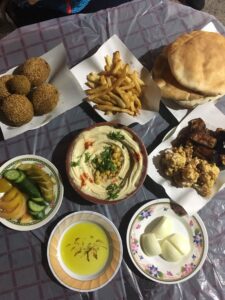
By writing this article I want to show my gratefulness to all the kind people that helped us during our travel because I realized that I let a part of my soul in Palestine and I brought home with me all the actions of kindness that we received. Palestine is the second Muslim country that I visited, after Turkey, I don’t know if I should connect with the religion or not but I felt really welcomed in both countries. These kinds of experiences make the difference during traveling because are the best memories to share with others back home and these experiences could be inspirational for other travelers too.
First of all, I want to start by saying that Couchsurfing works pretty good in Palestine, we were three girls and we found two hosts and both of them helped us very much and they were open to discuss and answer our questions. I will have another article reserved for Couchsurfing experiences from all the trip, there I will present more details about this way to travel.
In Bethlehem, our host was an English Teacher that was very nice to give us his first floor and the key without being necessary to adapt our schedule to his one. More than this, he offered us a tour in the city, presenting his perspective about the occupation and making us know the main dishes and dessert in Palestine. I felt his care for us from the way he was calling us “Sisters” or “Habibati” and because he was starting each time the conversation with us asking if we are hungry and what we have eaten during the day. He offered us the first falafel in our first evening in Palestine and we ended Couchsurfing in Bethlehem with a nice dinner at a local restaurant with an even better falafel.
We traveled for more than one week in West Bank and we felt safe and nice treated in most of the places visited. Another act of kindness came from a really helpful person that we knew from a common friend and gave us a one day tour Ramalha – Nablus – Jericho with stops in the villages around these cities. To understand how lucky we felt that day, I have to say that we wouldn’t suppose to meet this person because he had some health issues the day before and he wrote us to postpone the meeting. But in Palestine, we didn’t have Internet and most of the times neither wifi so we saw his messages when we arrived to Ramalha. While we were trying to figure out what we’ll suppose to do in Ramalha for one day and to adapt to the new situation, he sent us a message that in 15 minutes will come to meet us. It seemed that we had also a little bit of luck but his kindness and amiability can not be forgotten.
I ended my trip to Palestine by visiting alone a small town Abu Dis very close to East Jerusalem on the other side of the Wall. I needed this experience to have a closing of my traveling in Palestine, I didn’t reach any conclusion about the political situation but I’ve seen the biggest warm heart that literally took me from the street and offered me food and hosting for one night. I totally recommend to be open to travel to small towns and villages in Palestine because you’ll meet simple, kind, hospitable people. They don’t complain, they struggle with their daily life but in the moment that they can give their help, they will do it with an open heart.
Generations without childhood
Published by Ramona Diac on October 19, 2019
“I want to raise my children living their childhood because neither me, my father or my grandfather had it. This is the most important for me as a father, I want my kids to have a childhood.” I received this answer talking with a tour guide in Bethlehem who was giving workshops for children in the camps between 12 – 16 years old, about their civil rights and how they should react in case if they would be interrogated or arrested by Israeli forces. “The kids in the camps know how to talk about politics from a really young age, tell me where in Europe have you seen this?” I didn’t know how to answer because I had a beautiful childhood in my village and I wasn’t afraid that somebody could take my freedom away.
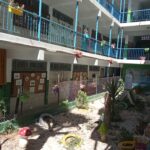
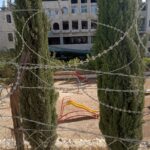
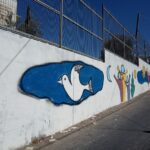
In another conversation, a father of two told me the same idea “I want for my children to live their childhood. Maybe I will teach them how to go to a peaceful protest but my priority for them is to be educated in order to become an activist. Even when I see kids throwing stones to the wall or teasing the soldiers, I stop them for a talk and I try to explain to them that they could be more powerful if they will be educated first. I became an activist at 10 years old and I was harassed many times by Israeli soldiers, I didn’t have a childhood.”
I felt that this is the most important consequence of the conflict between Israel and Palestine, today there are generations without childhood and children that are forced to learn to defend themselves too early. But this situation exists on both sides of the Wall because don’t forget that in Israel the military service is mandatory for boys and girls.
The first thing that we heard from a young man in West Jerusalem while we were waiting for our host was: “Everybody in Israel is a soldier.” “What about you?” I asked back. “I’m smart, I can not hold a gun because I’m bipolar.” How do you educate the youngsters to become soldiers, I’m wondering? Probably by convincing them that the country is in danger without their service or by promoting hate and racism. Where in Europe, you’ll prefer a diagnostic of having psychological issues and actually consider yourself smart in the same time? In both countries there are children affected by this conflict and we should be aware of this.
Resistance through Art – Banksy’s Art on the Wall
Published by Ramona Diac on October 19, 2019
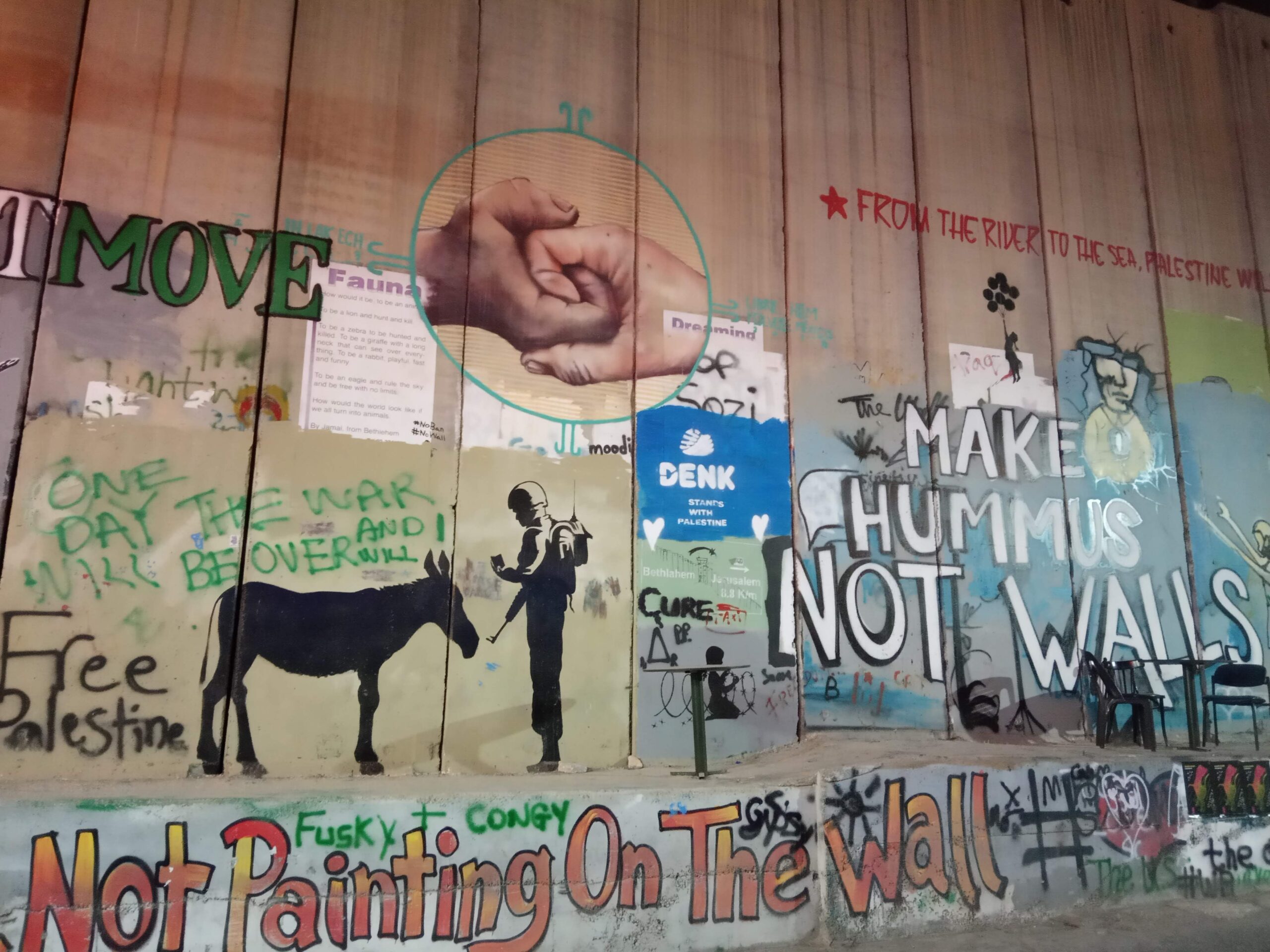
I’ve always been amazed about how people transform pain in beauty by art. This is happening in Bethlehem too through Banksy’s graffiti and all the other messages and drawings that tell us the stories beyond the Wall.
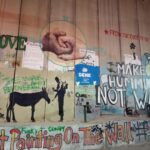
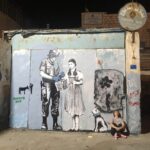
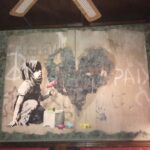
If you will travel to West Bank from Israel’s side, it’s impossible not to see a huge wall separating the two places. Israel considers it a security barrier against terrorism, while Palestinians call it a racial segregation or apartheid wall. Seeing it from both sides, as a visitor, I felt the limitation of freedom and more being unsafe. In our subconscious, when we build this kind of barrier, it’s a consequence of fear and a declaration of force not necessarily a way to have peace. I think this wall is actually a fail of humanity that instead of trying to accept the differences and to understand the reasons behind hating each other, they live in fear of knowing only what it had been told about the other.
But who is Banksy? I am not so educated in contemporary art so for me, it was the first when I heard about him, in Bethlehem when I saw the Wall and the Hotel next to it. According to Wikipedia he “is an anonymous England-based street artist, vandal, political activist, and film director, active since the 1990s”, pretty cool, no? I was touched by his way to tell stories putting together childhood and war, and I think this is another kind of activism that sometimes has a bigger impact on tourists at least. And I say tourists because, in March 2017, it was opened Banksy’s Walled Off Hotel located next to the Wall, helping to bring more visitors to Palestine.
We were lucky to be invited to an opening Gallery in this Hotel where young artists were presenting their work. There we met Yazan, a student at the Art University of Bethlehem, who had some pictures exposed in the gallery. In his work, I felt the anxiety, the sadness, and the sensation of living under occupation. The lines and the lack of color create the idea of the prison and just the color of the sun brings the image of hope.
Do you think Art could be a form of resistance in this situation? Is it possible that one picture can change mindsets and invites you to take action? Or do you think that these questions are too naive and actually every artist puts higher the fame and the economical interests than the meaning and the purpose of his art?
Airport and checkpoint experiences in Israel
Published by Ramona Diac on October 20, 2019
For different reasons we became afraid about how we should act at the entry in the country, I actually was very insecure if they will let me in. We heard so many stories about the intense security and the questions that they put before giving the permit to enter and we tried to prepare ourselves for this experience. First of all, we convenient to say that we travel alone and it was a good decision for the beginning because we could have compared our experiences. In my case, they were interested a little bit in my background, my job in Romania, the reasons for visiting the country, why I’m traveling alone and what I want to visit specifically. Anna, one of my colleagues from Hungary, stayed less than me because she said only that she is a tourist and travel alone and she received quickly the permit. Concerning the other colleague from Malta, Karen, the situation was a little bit different because she had to give more explanations and answers about the reasons for traveling alone, she had to wait around one hour in their office in order to receive the permission of going in. Why this difference? Probably because they are extra careful with travelers that could have an Arabic appearance and because they are also suspicious about solo travelers, backpackers that could be journalists or investigators in Palestinian areas.
When you travel in the West Bank from the areas A, B to area C, you have to pass a checkpoint, a barrier controlled by the Israeli Army in order to grow the security of Israel and Israeli settlements. All the Palestinians are checked each time they pass these control points and they should have their documents all the time with them. When we saw this intense military presence, we felt grateful that we are just European travelers that don’t receive too much attention from the soldiers, of course, they still verified our permits for visiting the country and our passports.
Every day, over 80000 Palestinians cross into Israel. Eighty-five percent of them are men who work in Israel. The rest come for medical, educational or other purposes. Traveling from Bethlehem to Ramalha we had to change buses in Jerusalem and to pass through Checkpoint 300. For me, it was a shock to see how Palestinians that don’t have the permit of residence in Jerusalem went out of the bus and waited outside for the soldiers who were checking us on the bus first. It felt totally unfair but at the same time, I was feeling lucky that I’m not in their place. I passed three different checkpoints during my travel there, Checkpoint 300 from Bethlehem to Jerusalem, another one from Abu Dis to Jerusalem, smaller but with the same security and from the Dead Sea to Jerusalem. The first two I passed by bus with locals and I could observe how they are checked, the last one we were in an Israeli car because we hitchhiked and we weren’t verified at all. I was prepared to show my passport and I realized that the driver wouldn’t even stop and I put my documents back in the bag.
On the day of coming back, we decided to pass the control together to see if it will be a different experience. Quick advice for you, it’s better to come earlier to the airport to be sure that you won’t miss the flight if the control will be more detailed. Going as a group it was easier for Karen because we all received the same questions and we passed together with the control point. We stayed in a long line and they verified all our luggage but it was ok. Be aware of what would you buy from Palestine because they will verify your bag too. I had a book about the right of education for kids in prison and when I saw that they open everything, I had some moments of despair…lucky me that I had also a notebook and maps from Jerusalem so it wasn’t so obvious. We passed the border all three and because it seemed too easy for me, I was still thinking as a paranoiac until the plane took off.
Volunteering in Aida Camp
Published by Ramona Diac on October 20, 2019
During our stay in Bethlehem, we went every day at Aida Camp trying to be useful in one of the three organizations in the camp, Alrowwad Cultural and Arts Society. Alrowwad, initiator of “Beautiful Resistance”, is an independent, dynamic, community-based non-profit organization that strives to empower children and women by forming behavior, knowledge and practices through creative and non-violent means. We stayed 5 days in this organization doing some translations of their brochure and newsletters and joining their education unit. Basically we prepared some activities and games with the kids that were coming to their center. Because we chose to do Couchsurfing in Bethlehem and not to have accommodation in the camp it was an awkward situation but we overcame it. For us, Couchsurfing was a way to save money and to interact also with people outside the camp to understand more about the occupation.
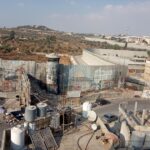


Aida Camp was established in 1950 by refugees from the Jerusalem and Hebron areas, about 1125 refugees living in 94 tents. Meanwhile, according to the UNRWA, the camp had a population of approximately 5,498 refugees at the end of 2014. On our first day, we were a little surprised to realize that we were walking in the camp without knowing that we were in the camp. I don’t know exactly what I was expecting but the camp is similar to a periphery neighborhood where some people live in deep poverty and some people found some ways to have better conditions of living. Some of the refugees were able to move or to leave the country but most of them don’t have this possibility and they still hope to receive their land back. The Key of Return is the symbol of the camp representing the people’s hope and right of having back their houses. The key is also a widely used symbol of the Nakba, as many Palestinians kept the keys to their homes when they were forced into exile in 1948.
One of my goal there was to interact with children asking them about their dreams and about what they would want to send a message to other kids from Europe. Very sweet and beautiful in my European mindset but I didn’t take into consideration the fact that these people are under occupation and answering my questions could be taken as a form of activism. Children in the camp are very smart and politically aware of what they should or should not do, even taking photos was a challenge. What I was able to do was to ask them about their future and it was really powerful to observe that most of them have big dreams. Being teachers, mostly the girls, or becoming doctors, artists or musicians these were the most often received answers from them. There were some situations when they said that they want to become nothing, I believe that this is an answer of a kid that lost his naivety and realized how complicated it could be to have a job in their country. This answer could be also related to religion in the girls’ case because maybe their families are not supporting them for having a higher education. On the other hand, in the last years, they became more aware of the right to education for girls and even if the religion doesn’t support gender equality, more than 70% of students in the Palestinians universities are girls.
With the help of the organization, we visited the school in the camp but because we didn’t have official approval, we didn’t attend classes or speak with teachers. It was a nice surprise to see such a colorful and peaceful environment and happy students that were welcoming us. This was a Governmental school for primary and secondary classes. It was interesting to see the change of shifts, in the morning were the primary classes with boys and girls mixed, for secondary they have girls classes and boys separated. In Palestine are another two types of school, private and UN schools. Regarding the private schools, they could be only for boys, only for girls or mixed. The UN schools are international like the American School, we met two girls from the camp studying there and they had a very good English and French, but they were saying that they work very hard every day.
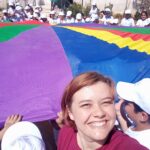
On our last day in the organization, we visited Al-Hijiri school in Dura village close to Hebron. We participated in an interactive activity called “We play and draw a smile”, and it happened exactly like that because all the students were overexcited to play with us and to meet us. The school was on a hill and quite small but the teachers and the children there succeeded to make us feel like home. I embraced their happiness and I took enough energy to remember this day as a very special one. After the activities, I liked very much that the principle with the other teachers and organizers had a meeting where they thanked for this day but they also tried to give some feedback in order to make better future activities. In the end, they offered us some Palestinians patisseries that we enjoyed a lot. I felt grateful that we had the opportunity through the Alrowwad organization to visit this school. I realized again that in small communities, schools are full of living, authenticity and openness to the new people. When we left, some students were running after our car shouting goodbye, I hope that I will have the chance to come back because their smiles left a mark on my memory.
What happens during Shabbat Dinner?
Published by Ramona Diac on October 21, 2019
Our adventure of Couchsurfing in Jerusalem brought us to a Jewish Host on a Friday evening. I knew that Friday makes part of the Jewish weekend but I’ve never witnessed a Shabbat Dinner so I didn’t know what to expect. I felt grateful to have this experience and to learn something new about a religion that I don’t have so much knowledge.
First of all, what does Shabbat mean? Shabbat is considered a day of rest, peace, inner harmony and holiness. In Torah, Shabbat commemorates the day when God rested from the creation of the world, literally the word means “he rested”. In Shabbat are included three meals: Friday night dinner, Saturday lunch, and the third meal in the late afternoon. For non-Orthodox Jews, Friday night dinner is the most popular Shabbat meal, this was the case of our host too, he was more an unconventional Jew that didn’t respect the traditions of the book.
We arrived at his place right in time for dinner’s preparation with the other guests that he already was hosting. He welcomed us and very kindly he invited us to help to prepare the dinner and space for it, while we were sharing our traveling experiences. I am not sure that the menu included traditional Jewish dishes because all of us were foreigners but the experience of working together was really nice. I was in charge of preparing the brown rice with vegetables, ginger and eggs, it was an interesting combination and I enjoyed very much to eat it. The other guests were preparing salmon in the oven with vegetables, potatoes and salads.
Because this holiday is a time when families come together, our host invited his mother to have dinner together. While he went to pick up his mother, I was in charge of heating for 5 minutes the bread in the oven. The funny thing was that the fish needed more time to cook so another person raised the temperature and the bread started to burn. I realized in time what was happening but the bread was still burnt, luckily nobody had a problem to serve a bread a little bit black.
We started the Shabbat dinner with praying and after the host blessed the crispy bread (called challah) and the wine. Even it was in Hebrew, he explained to us that he thanked God for the meal: Blessed are you, Lord our God, King of the universe, who brings forth bread from the earth. He told us that according with the tradition there are also some songs used for this part of the dinner. We shared the bread and the wine in little special cups and we started to eat. In order to respect the rest day, after each dish, we were cleaning our plates with bread and eating it afterward. In this way at the end, we didn’t have too much to dish-wash. We ended the dinner quite late because it was prolonged by the conversations that we had but after all, I enjoyed the simplicity of that evening and the Jewish hospitality.
10 Reasons why you should visit Jerusalem
Published by Ramona Diac on October 22, 2019

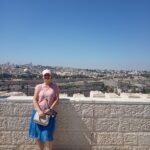
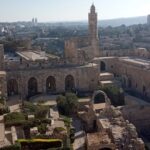

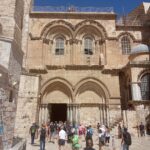

- Jerusalem is one of the oldest cities in the world full of History and Holy places for three of the biggest religions in the world: Judaism, Christianity and Islam. That’s why you should definitively visit the Old City of Jerusalem, divided into four quarters: The Jewish Quarter, The Armenian Quarter, The Christian Quarter, and The Muslim Quarter. This one-kilometer walled-in area in the center of Jerusalem is one of the most intense places seen and cannot be missed.
- If you are a Christian, you should visit the Church of the Holy Sepulcher in Jerusalem, the place both of the crucifixion and the tomb of Jesus of Nazareth. This is one of Jerusalem’s main landmarks, going there I had to swim through the crowd of many pilgrims and visitors.
- I visited Jerusalem before Rosh Hashanah, the Jewish New Year. These days were very important for the Jewish community, praying days to the Western Wall.These prayers are either spoken or written down and placed in the cracks of the wall. The wall is divided into two sections, one area for males and the other for females. The Western Wall is free to visit and is open all day, year-round. Women and men should be dressed modestly to visit it and to pray, women should have their legs and shoulders covered and the men should cover their heads.
- One of the most impressive holy sites from the Old City is the Dome of the Rock,the Golden Mosque. The Temple Mount is the third holiest site for Muslims behind Mecca and Medina. In Muslim tradition, this is where the Prophet Mohammad made his “Night Journey” to the throne of God. Visitors enter the complex through the Mughrabi Gate near the Western Wall.
- For buying gifts or memories from Jerusalem you should check The Old City Market. The most crowded part is in the Muslim Quarter, there is a labyrinth of alleyways lined with shops selling everything from handmade jewelry and exotic scarves to good food and ceramics.
- For those wishing to explore more about the History of Jerusalem, I invite you to visit the ‘Tower of David’,the citadel dominating views as you enter Jaffa Gate started life as a palace of Herod the Great. Also used by the Romans and Crusaders, the structure was extensively remodeled by the Mamluks and the Ottomans. Today it’s home to the impressive Museum of the History of Jerusalem, which tells the city’s story in a series of chronologically arranged exhibits starting in the 2nd millennium BCE and finishing in 1948.
- If you need to disconnect from the crowded Old City, I invite you to climb the Mount of Olives, associated with Christian and Jewish traditions, and is named after the olive trees that previously adorned its slopes. During the First and Second Temple Periods, in particular, the mount was a location of great significance and was the center of Jerusalem’s life. Still today the mount is considered a place of holy significance and location of pilgrimage.
- I am interested in Archaeology and the City of David is a perfect place to explore more about the ancient period of Jerusalem. The City of David is located outside the walls of today’s Old City, south of the Temple Mount. Approximately 3000 years ago, King David conquered Jerusalem from Jebusites and established it as his royal city. David’s choice of Jerusalem for his capital was based in part on the presence of a perennial water source, the Gihon Spring, as well as the city’s strong defenses, its central location in the lands of the Israelite tribes.
- When you want to take a break from History and city-sight seeing, Jerusalem could provide you unique shopping experiences in its many markets. In this case, you should visit Machane Yehuda Marketor “shuk”, thee largest market from Jerusalem. Here you will find from fresh, local produce, to amazing spices, artifacts, handmade goods and jewelry.
- For me the best part of Jerusalem was the feeling and vibe of Thursday evening, the city is so alive in the night because it’s the beginning of the weekend in Jewish Communities. Seeing so many people on the street celebrating and having different kinds of fun makes part of this mosaic of joy.
5 cities you should visit in Palestine
Published by Ramona Diac on October 22, 2019
Palestine was safe to visit and gave us a lot of beautiful surprises during our travel there. I was mostly impressed by the people’s hospitality and kindness but for this article, I decided to write a summary of the places that I visited in West Bank. I select 5 cities that are easy to visit but I strongly invite you to explore more outside these cities in the villages and small towns to reach another face of Palestine too.


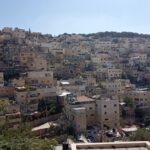
- Bethlehem – was our first city visited in Palestine, situated 10 kilometers south of Jerusalem. It is quite easy to reach by bus 231 from Damascus Gate Bus stop, and the price is around 7 shekel, less than 2 euros. It’s one of the most touristic cities in Palestine, being visited by many groups of peregrines, approximately 1.4 million in the last year. The main touristic point is the Church of the Nativity, the birthplace of Jesus, and the oldest major church from the Holy Land. Surprisingly, I saw many groups of Romanians tourists in the five days spent there. Besides the Christian importance of this city, tourism was increased lately because of the political situation too. There are many people coming here to visit the Refugee Camps, they could have political tours and they could see the messages and the graffiti on the Separation Wall. Another touristic objective that brings more people to Bethlehem is the Walled Off Hotel, or Banksy’s Hotel, situated in one of the few areas of Bethlehem inside “Area C”, under full Israeli control. However the hotel can be visited by both Israelis and Palestinians, its purpose is to create a space where Israelis can come to learn more about the reality lived by Palestinians.
- Hebron – is known as the largest city in the West Bank and the second largest from Palestine after Gaza. It’s situated south of Bethlehem, being easy to reach from there by a shared taxi, for approximately 10 shekel. Here you can see the consequences of Israeli settlements because more than 20% of Hebron is part of Area C and the military presence is quite intense there. This situation is in contradiction with the city’s name because, in both Hebrew and Arabic, Hebron means “friend”.
- Ramallah – is situated 10 kilometers north of Jerusalem, we traveled there from Bethlehem and we had to come back to Jerusalem by bus and change there the buses and the bus station. We took bus 218 from another station than the Damascus Gate, ask for directions because there are three different bus stations for different destinations in Palestine. Ramallah is known as the place where is the headquarter of the Palestinian Authority and of embassies that recognized Palestine as a state. Ramallah is not a very touristic city but it’s considered the most liberal city of Palestine.
- Nablus – traveling further to the north of West Bank, we reached Nablus, one of the most traditional city in Palestine. We visited the huge market in the old city and we realized that Nablus is an important commercial and cultural center that deserves a visit. Nablus is known for its cuisine, if you are going there, you have to try the Palestinians deserts as Kunafa, called also Nabulsi sweet. Other types of sweets are “Tamriya”, mabrumeh and ghuraybeh, a plain pastry made of butter, flour and sugar shaped as fingers or spirals.
- Jericho – we finished our tour in the West Bank in Jericho, situated in the Jordan Valley, west to Jerusalem. This is a perfect place for the archaeology lovers because there are many sites discovered by archaeologists that date back to 9000 BC, that’s why Jericho is considered the city with the oldest surrounding wall. The city has many Christian tourists because there are several pilgrimage sites, one the most visited is the Mount of Temptation. We had a short stop in Al-Ouja village and we tried Jericho’s pastry. I honestly recommend you to go there because we were welcomed and treated very well. Once again, I was the witness of Palestinian Hospitality, when we left the store, we received some pastry from the house.
How is history taught in Palestine and Israel?
Published by Ramona Diac on October 24, 2019
We know already that education is the most powerful weapon which you can use to change the world, but this statement is a two-edged sword depending on the person using it. In this context, History is a weapon too, most of the time in the service of the state and it’s used to justify the power or to deny it. I used to believe that studying History will help me to be closer to the truth and more solid in my beliefs, in time I realized that studying this subject helped me to put more questions and to lose most of my beliefs.
History has an important role in the schools of Palestine and Israel too. I’ve had a conversation with a father of two students who told me very sure about himself that he wouldn’t let his children learn a hatred History against Israel. When I asked him more details about the History in books, he told me that it’s mentioned that Haifa is a Palestinian seaport or that Galilee, Nazareth are regions of Palestine, without having hate in the schoolbooks. Researching more about this subject, I found out that Palestinian History doesn’t put too much accent on the ancient Jewish presence in Palestine and presents Zionism as an enemy movement.
On the other side of the Wall, the historical textbooks were criticized as being anti-Palestinians, we could see this in the research of a professor of language and education at the Hebrew University of Jerusalem, Nurit Peled-Elhanan. She has a paper about the way how the Arabs are described in Israeli schoolbooks called “Palestine in Israeli School Books: Ideology and propaganda in education”. Talking with our hosts in Tel-Aviv, they also recognized that the hate against Arabs is promoted in school and that they were forced to complete the military service even if they didn’t like it.
In this context, I wonder…should we or we should not remember the past? If the people wouldn’t remember their pain maybe the suffering will stop. Where is the truth? What do we really know about this world? Should we question everything? But how to live without choosing what to believe? People are emotional, weak and idiots…but in this way are authentic pieces of art, without their imperfection, I wouldn’t be here struggling to find some clarity in this storm.
Maybe people shouldn’t have memory, maybe history shouldn’t exist and humanity shouldn’t learn from their past because anyway, they don’t. We pretend that we want to do good around us, that we want to be in the service of people or that we want to give better education to our children. Are we really doing this? What do we understand and learn from our past? Help me to find some light in this twisted mind of mine. Could you imagine a society without memory? Without past? Could we be happier, kinder and more reliable like this? Is it History to blame for this circle of suffering or the people? Could we learn to deal with our emotions, differences and our past? Be honest! Be real!
What could I wish for this world in order to still exist? Is it my trouble or not? Should it be? I know nothing…